The honest answer to "how much energy does this server actually use" has historically required onsite instrumentation. Power meters, monitoring software, a baseline window, a willing facilities team. For a single server in a known environment, that is tractable. For a procurement decision involving hundreds of candidate replacement configurations across multiple vendor generations, it is not.
Machine learning closes that gap. With enough measured records and the right model architecture, an accurate estimate of a server's energy profile can be derived from its hardware configuration alone, CPU specs, RAM, release year, without needing physical access to the machine. This is the core of how Interact works under the hood. Here is what it takes to make it accurate.
The dataset
The model trains on hundreds of filtered records published by SPEC, the industry-standard benchmarking consortium. Each record pairs a server's configuration with the measured output of the SPECpower_ssj2008 benchmark: idle power, full-load power, and performance score at full capacity. The dataset is public, the methodology is standardised, and the underlying measurement is consistent enough across submissions to support a model on top of it.
The model
The architecture is a three-layer neural network. Inputs are CPU cores, CPU threads, CPU frequency, RAM capacity and release year. Outputs are predicted idle power, predicted full-load power, and predicted performance at full capacity. The choice of architecture and the specific combination of inputs were not the first guess; they emerged from comparison across a series of candidate models, with the combination producing the highest accuracy retained.
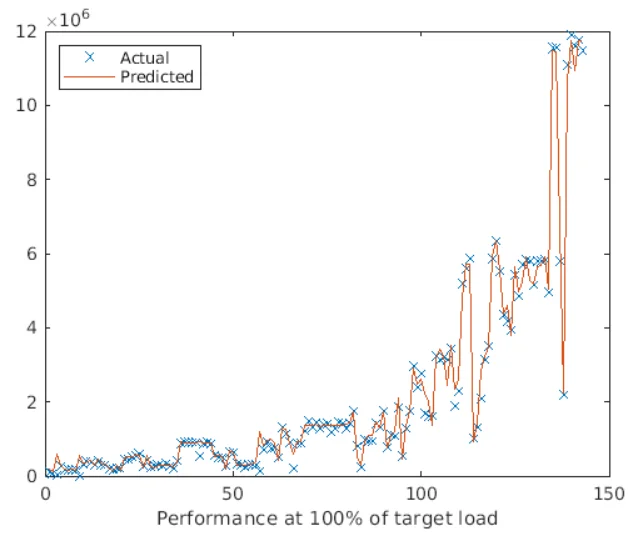
The predicted values feed into the energy algorithm, alongside server utilisation and PUE, to produce annual energy consumption and workload for any specific server configuration. Run the same engine across thousands of pre-configured server models with their list prices, and it can recommend the best replacement option for an existing fleet, balanced across energy, CO2 footprint and cost.
What the approach gets right, and where it stops
The advantage is reach. We can estimate the energy and carbon impact of a hardware decision before anyone places the order, without needing instrumentation on the candidate kit. That is what makes provisioning decisions defensible on measured evidence rather than vendor projection.
The limit is dataset coverage. Where manufacturers publish, the model learns. Where they do not, and the hyperscalers' custom-designed servers are the obvious case, the model has nothing to learn from. The next step for the industry is more disclosure from more manufacturers. Better data in, more honest answers out, for both suppliers and buyers.